
Our Retrospective cards have been very well received by Estonian leaders. One of the organisations that uses them in team meetings is the Estonian Health Insurance Fund. Marion Kalju, service manager for quality of care, and Signe Borissov, service manager for ensuring the network of health service providers, share their experience of running retros in their teams.
A retrospective meeting is by nature a look-back meeting, where a team analyses its field of work and discusses what has worked well, what should change and which opportunities have not yet been used. Every team member’s opinion counts, everyone gets to speak and problems are brought to the table without judgement.
For a retro to succeed, however, preparation is very important. So we first asked the Health Insurance Fund’s service managers what they did to make their retrospective meetings succeed.
How did you prepare for the retro?
Marion: I was running a retro for the first time, so I prepared thoroughly. As the goal was to look back at how our service core team had worked from the beginning of the year to the day of the meeting, I looked for a retro exercise that would give me, as service manager, an overview of different aspects, e.g. roles, work processes, joy at work and so on.
Once I had found a suitable exercise, I prepared it on the Miro platform so that we could do the retro in a virtual space and everyone would be comfortable working there. Before running it, I also went through it with Monika from Sunergos to feel a bit more confident.
I also read in various sources about which agreed rules help people take part in a retro actively, safely and openly and help run the meeting effectively. Here are some examples of the recommendations I followed:
- We take part actively and are present.
- We are respectful and open when listening and sharing, and don’t judge.
- Confidentiality!
- There are no right or wrong answers.
- We bring out both the good and the bad.
- Negative feedback is not criticism – it helps us grow.
- Your first thought or feeling is probably right.
Signe: I prepared for the retro as I would for any discussion or meeting: I worked out for myself what I am doing, why I am doing it and what I want to achieve (in other words, I set a goal). I chose tools that suited me for running the retro and used the Miro platform.
How exactly did you run your team’s retro and what did you focus on?
Marion: I used a retro exercise that focused on roles, work processes, joy at work, learning, values, goals, communication and so on. The retro lasted 2.5 hours (including a break).
I started with an introduction and explained why we need to do a retro. Then we agreed on the rules, followed by a warm-up exercise. After the warm-up, we did an exercise based on the topics described above, and to close the shared thoughts we agreed how to move on with these insights: what we will continue doing, what we will deal with right away, what later, and what is nice to have but not a priority.
Signe: I started with a warm-up exercise that has become popular, and then gave the core team an overview of my expectations of the retro and of the goal I had set for it, what I had planned and how.
What value or new knowledge did the retro give you?
Marion: It gave us the chance to step out of the context of everyday work. The retro helped steer the core team to think and reflect on different aspects, and we were able to sum up the most important thoughts. During the retro, the pain points emerged, but so did what is going well. This way I learned in which aspects the core team is in the “red”, “yellow” or “green”, and what we should do next to increase satisfaction.
Signe: I got confirmation that my core team is very honest and open and that the level of trust between us is super high. We dare to talk about both the good and the not so good, and we dream in order to find possible solutions. And we really are a team – one for all and all for one! As all the thoughts from the retro were written down, it also became clear how we will move forward. In other words, the retro helped me as a team lead to create a clearer plan and vision for the way forward.
The retro helped me as a team lead to create a clearer plan and vision for the way forward.
Signe Borissov
What are your three most important tips for running a retro so that team members will be happy to take part next time too?
Marion: Prepare properly – especially if you are running a retro for the first time. Think about which retro exercise is relevant at the moment and make yourself a schedule of how much time you will spend on what. If there are people taking part in a retro for the first time, warm-up exercises definitely help. They also give you a pretty good sense of the participants’ mood. Agree on rules before starting the retro, so that participants feel safe sharing their thoughts and the retro is effective. If you are doing it for the first time, ask participants at the end of the retro for feedback on how to continue with retros.
Signe: First, create an accepting atmosphere in the team and keep in mind yourself that no thought is wrong. Second, create a framework together, i.e. set how much time goes to each topic, because this helps you stay on schedule. Third – relax!
A retro is a shared team meeting with the aim of analysing the previous stretch of work and thinking about what could be done better. In this light, all leaders should be very interested in holding retros regularly. Yet we have heard here and there that it shouldn’t be done. What would you say to those who claim a retro is a waste of time?
Marion: A retro creates separate time, space and structure for gathering feedback. A retro also strengthens the team’s sense of safety and trust, which in turn supports better cooperation and better results, and that should be every leader’s goal. A retro can take ten minutes or half a day – either way, it is not a waste of time.
I believe the more retros you run, the shorter the preparation time. As for wasting participants’ time, I think it makes perfect sense for the team to agree at what moments, how often and for how long to hold retros. After our two-and-a-half-hour retro, it was clear to all of us that a retro with this structure and length would be enough a couple of times a year, but quicker ten-minute retros could be held much more often.
Signe: I wouldn’t force anyone to do a retro if it really goes against the grain. Like preparing for any discussion or meeting, a retro takes time, and it also takes courage from the team lead to look in the mirror. A retro is meant for looking in the mirror, and it would be surprising if everything looking back at us was to our liking. For me it was not a waste of time – on the contrary, I learned where to direct my focus more so that I, my team and the service keep developing.
A retro takes the courage of the team lead to look in the mirror
Signe Borissov
Marion, please share your experience of using a retro warm-up question with an external partner. What did you ask, how did it work and what was the feedback?
Together with a fairly academic partner, we are implementing a change and are only at the beginning of that journey. A couple of discussions had taken place, and everyone had many thoughts going in very different directions. It was hard to sense people’s mood.
We had worked with this partner for years, so it was quite unexpected for everyone when I opened the meeting by asking each person to describe their feelings about the previous discussions and the upcoming changes by comparing them to a natural phenomenon or a state of nature.
At first there were smiles, then people took time to think, and then we all shared our feelings openly. One person had an expectant feeling, like in spring when the weather is already getting a bit warmer but a cold wind still blows through now and then. Another was in a foggy forest and couldn’t find the path, and the forest got deeper and deeper as they moved on. There were also those who were very positive that it would become something good, like the peony bush at home that the husband at first wouldn’t allow to be planted in the garden, but which has now grown into a lush bush that blooms more beautifully every year.
These comparisons gave me a completely different kind of feedback and sense from a non-academic angle, and it was a very good warm-up for the discussion that followed.
It created excitement in the partner, and they admitted that it was actually very nice to share their feelings this way. They had never done a retro before, but among themselves they floated the idea that maybe they should try it sometime.
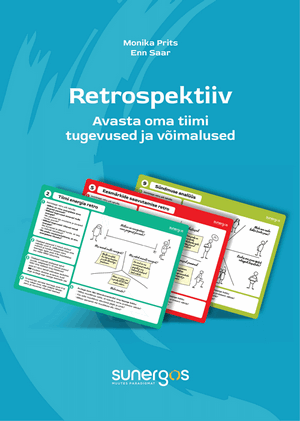
If the topic interested you and you would like to know more, take a closer look at our retro card set or contact our development partner Monika Prits, creator of the retro cards, who also trains retro facilitators.
Retrospective Toolbox
- 10 guides for running team retros
- Price €49 (incl. VAT)