

Over the past year, the Ministry of Social Affairs has applied the principles of service-based management to policy-making across its area of government.
Why did they take this path, and how did the organisation’s work change along the way? Kelly Vaabel, development adviser at the Ministry of Social Affairs (SoM), shares her experience.
The Ministry of Social Affairs was supported in implementing the changes by Sunergos service-based management consultant-coaches Monika Prits and Enn Saar.
Why did the Ministry of Social Affairs decide to move to service-based management (SBM)?
The decision came from several interconnected needs.
-
We were fragmented. The way we had designed and managed services no longer worked well enough and didn’t offer satisfactory solutions either to our customers or to the organisation itself. Services and processes were managed mainly on the basis of legislation and internal regulations, not the customer’s real needs.
-
The impact of crises. A critical push for change also came from two major crises: the COVID-19 pandemic and the war in Ukraine. These events brought out the vulnerabilities of the social and healthcare system especially clearly. Besides limited crisis resilience, there were also problems of little flexibility and unclear areas of responsibility. The crises showed that we lacked a complete overview of who our customer is and what services they actually need. Nor was there a shared understanding of whether our political decisions and organisational agreements really serve the interests of the customer and society. For example, it became clear that our administrative, procedure-focused management style didn’t allow us to respond quickly and effectively enough to changing needs.
-
Resources decreased. Although our resources – people, money and time – kept decreasing, society’s expectations of the quality and availability of public services actually grew. The need for a new, more systematic approach was clear.
SBM puts the person, i.e. the customer’s real needs, at the centre. For us, this meant that policy-making and service design had to be joined into one process that always started from the customer’s needs, not narrowly from legislation. We became aware of and agreed on who exactly the customers of social and healthcare services are, what their needs are and which services meet those needs most effectively. With SBM, we also wanted to stop duplicating services and reduce fragmentation both within agencies and within the area of government.
How was the change process supported within the organisation?
At the Ministry of Social Affairs, the launch of the change was actively supported by the ministry’s management, led by the secretary general. We were only able to dive into the activities so systematically and with such momentum because the management was strongly involved in planning and launching the changes. Introducing a service-based approach would not have been possible any other way.
Roles and responsibilities within the organisation must have changed now. How?
Here it is important to distinguish between core services and support services. The ministry itself doesn’t offer any core services to end customers. We deal only with support services, which we offer internally to our implementing agencies.
The ministry shapes social and health policies, which are divided into policy areas led by policy leads through the core teams of the policy areas. The core teams themselves cut across structural units and include people from the implementing agencies who hold the role of service manager.
In total we have six implementing agencies:
- TEHIK, the IT partner of all our implementing agencies;
- the National Institute for Health Development;
- the Social Insurance Board;
- the Estonian Health Insurance Fund;
- the Health Board;
- the State Agency of Medicines.
With the introduction of SBM, roles and responsibilities have changed significantly. Whereas management used to be traditional, so-called structure-based and hierarchical, top-down, we have now consciously moved towards more flexible management based on cooperation and trust.
A rigid, hierarchical management style, where decisions are made at management level and passed down for execution, didn’t allow us to respond quickly or flexibly enough either to the changing expectations of customers and society or to unpredictable situations. It also stifled employees’ involvement, motivation and courage to offer and find innovative solutions.
In management, too, we are moving towards applying a service-based approach, putting cooperation and shared responsibility at the centre of the policy areas’ core teams. The teams in turn involve the service managers of the implementing agencies. This way we can quickly bring the real needs and practical experience of service users into policy-making. Processes become more flexible and faster, and can meet customers’ needs more precisely.
Within the ministry, roles and responsibilities are now more clearly defined.
- The minister holds the political vision and sets priorities.
- The deputy secretary general defines clear policy goals for their area.
- The policy lead, together with their core team, is responsible for putting the goals into practice.
- The head of department (portfolio manager) manages the ministry’s resources (time, money, people), working continuously with policy leads to use resources most effectively.
- The secretary general leads the ministry as a whole and is responsible for achieving the strategic goals of the whole area of government and for using the budget effectively.
With this division of roles, we are moving towards private sector practice. Responsibility is decentralised, and leaders rather coordinate, supporting employees and enabling them to find solutions themselves.
Changes have also taken place in how internal support services are organised. Each service has a support service lead who is responsible for the functioning, quality and development of the support service. Several support services have moved to working in core teams, which means that services develop based on the needs of internal customers, in cooperation with them and in constant contact with service users.
How did involving employees and changing their mindset go?
The biggest test has been the complexity of attitudes and new practices taking deep root. At the beginning of the SBM journey, it seemed that changing the mindset would be a simple task, as employees were enthusiastic and ready to come along. Looking back, however, it is precisely the real change of mindset that has proved the most complex and time-consuming task. Change management rests on the realisation that a change of mindset requires cognitive development, which happens gradually. Just sharing information, workshops and trainings is not enough. Real change happens when employees start to understand and apply the new information and critically reassess their existing practices.
Involving middle managers (in our case heads of department, whose role in this process is critical) has been a real challenge. They are used to a hierarchical management style, but now they have to adopt a completely different approach: to be supportive leaders who don’t intervene directly in every employee’s tasks, but rather focus on improving the working environment and managing resources.
This change has been hard for them, and its meaning wasn’t communicated clearly enough at the beginning. Heads of department’s fears, uncertainty and lack of knowledge have been a significant obstacle in carrying out the change. So we have learned that heads of department must be kept constantly in the loop. We must give them enough time to adapt and also create opportunities to express their concerns. Practice has shown that if leaders’ fears and questions aren’t given enough attention, it isn’t possible to change the organisation.
The second challenge directly related to changing people’s attitudes and mindset has been underestimating the need for continuous communication. The initial understanding that changes happen by themselves after information has been shared once turned out to be wrong. In reality, we have seen that information doesn’t always reach everyone quickly enough, and people need repeated explanation and time. That is why repeating messages, further explanation and constant communication have become everyday practice.
The third challenge concerns leaders’ readiness and the pace at which they move along with the changes. This has varied. Some middle managers have adapted to the changes quickly and are actively applying the new approach. Others are still trying to control processes in the old way and haven’t yet dared to let go of their previous role. This situation brings role conflicts and misunderstandings about areas of responsibility into the organisation.
In short, the biggest challenge in involving employees and changing the mindset has been realising that it is a continuous, long-term process that requires consistent attention, clear communication and active support at all levels of the organisation.
It is a continuous, long-term process that requires consistent attention, clear communication and active support at all levels of the organisation.
The move to SBM is the future of many public sector organisations.
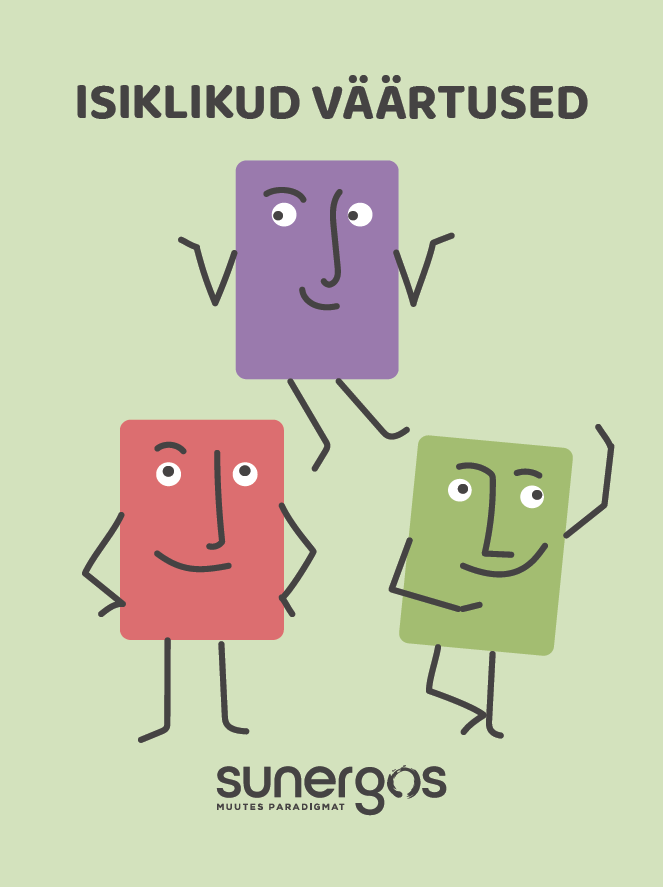
The cards are based on Shalom Schwartz’s theory of values, which focuses on how people’s values shape their attitudes and behaviour.
Get your own set of personal values cards here, or contact our development partner Monika Prits, creator of the cards, who also runs trainings on how to make the best use of these cards in your work.
Tool: Personal values
- Price €69 (incl. VAT)