


Moving to service-based management changes how the whole organisation works, but it is the leaders who have to go through the biggest change.
“Less climbing onto the stage and more empowering people,” advises Juta Urbalu, head of the development department of the Ministry of Social Affairs (2022–2026) and an enthusiast of service-based management.
The value of a service-based organisation is created where customers’ needs, experience and cooperation meet. While the theory may be clear to everyone in the organisation, it is the leader who must really take holding the focus into their own hands.
The leader’s roles in an organisation with service-based management are:
· to define a clear direction and hold it;
· to consistently bring out the customer’s view;
· to shape a working environment where the team creates value together rather than simply completing tasks.
That it is the leader who must be the one who steers and the one who enables, connecting the different parties into a whole and removing obstacles along the way, was also experienced by Juta Urbalu, who led the development department of the Ministry of Social Affairs during the critical period of the transition to service-based management. Here Urbalu talks in more detail about how, on top of her everyday work, she also had to change her attitudes and at times make difficult decisions. All to give the team more freedom – and to discover how well the new system eventually started to work.
Pain points that cried out for change
At the Ministry of Social Affairs, the move to service-based management didn’t start with a big hurrah, but rather with a fairly uncomfortable realisation that we couldn’t go on in the old way.
Until then the ministry had worked according to a classic function-based management model. Each department dealt with its own topics, and each agency had its own priorities. So every year we managed to “surprise” each other with our work plans and projects.
The main pain points were:
· so-called silos;
· unclear roles;
· fragmented goals;
· a great many priorities;
· insufficient resources;
· random, unsystematic cooperation.
We realised that if we really want better services and clear management, small process improvements are not enough. The management logic itself has to change – and not only in the ministry, but across the whole area of government.
From confusion to a system
The transition was not straightforward.
We went through a fairly classic trajectory of change, which started with great confusion, but gradually understanding came, followed by putting the new system into practice.
We essentially took our work in the ministry apart. We physically put all the topics on the table, including those no one had yet had time to deal with. There followed a great many discussions, workshops and debates. But slowly the framework began to take shape. There was an “aha” moment. I understood that we weren’t only changing how work is organised, but also the management system. At its centre came policy areas and core teams, i.e. cross-agency teams responsible for achieving specific goals.
That changed the whole logic. The question was no longer what one department does, but how to achieve the goals of the policy area as a whole.
How have the changes changed us?
I was actively involved in the project for moving to service-based management, but at the same time I was also the leader of change in my own department.
My task was not only to organise the work, but also to explain why the change was needed at all. I had to give the change meaning and keep the focus on the strategic goal even when it tended to disappear under everyday work.
The second task was to keep roles clear. Who is the policy lead? Who belongs to the core team? Where does policy end and a service or support service begin? These were not only questions of organisational structure, but also concerned everyday work organisation.
And the third, perhaps even the most underestimated role, was bearing the tension. Change always creates resistance. Sometimes the resistance is rationally understandable, but sometimes it is caused by old habits. As a head of department, I often had to deal with bearing these tensions while also supporting my team. Did I always succeed 100%? No, certainly not, but I gave my best every day.
How did the head of department’s role change?
What changed most during the transition was my role as head of department.
Before, leading a department largely meant leading on content. I held meetings, solved problems, made decisions. I felt that as a leader I always had to know how things work and what the right solution is. In the service-based model, that no longer works.
I became more of a people leader and a keeper of the system. My role was to make sure the right people work in the right teams, that priorities are clear and that obstacles are removed.
This of course meant a different kind of leadership.
· Fewer answers and more questions.
· Less solving and more prioritising.
· Less climbing onto the stage and more empowering people.
The hardest change was giving up control.
One quiet illusion is that if you are the leader, you control the results. In reality, that’s not how it is. In the service-based model it becomes very clear that results are created in teams whose work you don’t do yourself. And yet you are still responsible for those results.
That is a pretty uncomfortable place for a leader. Especially uncomfortable where the leader feels like a fish in water and “knows better how things should work”.
I am not free of this sin either. At first I still interfered too much in the work of the digital development policy area and the organisational development support service team. Only later did I realise that I was disrupting them. Really! My interference no longer brought clarity, but instead confused who should actually be cooperating with whom.
Hindsight, or what did I learn?
In theory, service-based management seems logical. In practice, problems arise when the organisational culture doesn’t keep up with the system. The framework can be put together quickly, but changing the mindset takes years.
· For example, being responsible for a policy area means having to summon the courage to make decisions. Not everyone wants this role.
· Some people are actually much better as experts than as leaders. And some heads of department would actually be better in the role of policy lead.
Decisions based on these factors must also be made – both by the person themselves and by the organisation as a whole.
For me, the hardest moment was probably when I really had to let go of the idea that as a leader I have to make all the important decisions myself.
When the policy leads and core teams started working, there came a moment when I simply needed to trust them. My own values and leadership principles helped me very clearly with this. I was also blessed with the world’s coolest policy leads and support service lead. I trusted them, and I can honestly say that I never had to regret it.
And finally – I remember a summer holiday when, for the first time in several years, I was away for 3.5 weeks in a row. When I got back to work, nothing was broken. All the agreed topics were on the table, not a single ball had been dropped and my inbox hadn’t exploded. Honestly, it was the best feeling in the world.
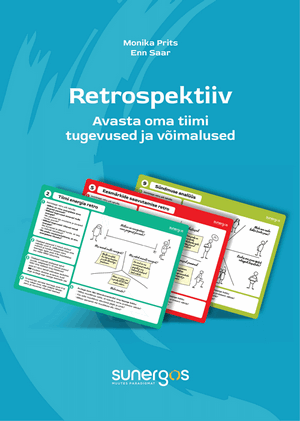
A retro is a tool that makes it possible to analyse quickly and in a structured way what to continue and what to change in how the team works. Get your own set of retro cards here, or contact our development partner Monika Prits, creator of the cards, who also runs trainings on how to make the best use of these cards in your work.
Retrospective Toolbox
- 10 guides for running team retros
- Price €69 (incl. VAT)