


In an era of cuts and smarter use of resources, more and more public institutions can’t avoid moving to service-based management. But not everyone has to reinvent the wheel. These five “pitfalls” could easily be avoided.
The lessons of the journey to service-based management (SBM) are presented by Kelly Vaabel, development adviser at the Ministry of Social Affairs, and Juta Urbalu, head of department.
The change was supported by Sunergos service-based management consultant-coaches Monika Prits and Enn Saar.
Lesson 1: Change needs a leader with a mandate
Kelly Vaabel: At the Ministry of Social Affairs, the move to SBM began with high hopes. The secretary general’s vision of a management system that would connect political will with the reality of implementation was inspiring.
The first experiences of success weren’t long in coming either: networks were launched, kick-offs were held, a common language was created and people worked in a shared rhythm. But over time this enthusiasm splintered. The number of participants in the networks decreased, priorities shifted and energy was directed to everyday work. The SBM project team tried to keep the focus, but as the team’s influence was limited, it became clear that enthusiasm alone doesn’t bring change.

Kelly Vaabel
For me this was a big lesson. A systemic management innovation that spans several organisations must be led by one person or unit that, in addition to enthusiasm, has a clear mandate and a place at the decision-makers’ table. Otherwise the drive to act is doomed to fade, and through inertia everything carries on “as it has always been done”.
Lesson 2: “I assumed everyone knew, but…”
Juta Urbalu: For some reason, the default assumption is that all leaders know what our country’s strategic planning framework is and how it connects with SBM. People also tend to assume that SBM is some working model that can be quickly written down and simply transferred one to one to every area of government.
The reality, however, is different: everyone interprets SBM in their own way, and we are still answering the question “WHY SBM?”… The explanatory work – that although SBM is based on shared principles, each area has to develop its own management system – took a long time.
We learned from this that even when the team is motivated, change needs clear messages so that everyone understands it in the same way.
Lesson 3: Involving middle managers isn’t enough – they also need support
Kelly Vaabel: The Ministry of Social Affairs’ goal in moving to SBM was clear: to offer customer-centred services, be adaptable and meet society’s expectations at a time when resources are constantly decreasing. Many discussions had been held to achieve this; it seemed that the roles were in place and everyone was involved.
In real life, however, a different picture emerged. The leaders were not all equally ready. Under SBM, substantive work is led in cross-structural core teams, but people in units. Not all leaders have adapted to this. Even today it remains unclear who is responsible for action plans, budgets and workflows. That is why involvement alone isn’t enough. Middle managers need their new role made understandable, while also being offered real support. If leaders aren’t helped to move towards coaching leadership, it is precisely they who become the bottleneck of the change process.
But in moving to SBM, it isn’t only middle managers who need support – the role of top management changes too. In SBM, substantive work and people management must be clearly separated so that activities aren’t duplicated at different levels. In leading, supporting and developing people, the management keeps in touch with the heads of department, who are responsible for the related resources. On substantive topics, however, communication with the policy leads goes through the deputy secretaries general and the secretary general.
In moving to service-based management, it isn’t only middle managers who need support – the role of top management changes too.
Lesson 4: people cooperate, not management systems
We have now reached the stage in the organisation’s development where we are about to make a second structural change. The new structure of the Health Insurance Fund will be based on portfolios: instead of the previous twelve departments, there will be eight portfolios.
The portfolio manager remains responsible for drawing up and implementing the strategy and vision of the service portfolio, setting goals and metrics, monitoring and analysing results, creating an environment where people can succeed, and leading. The service manager remains responsible for the functioning and development of the service and for customer satisfaction. We can also already see that some service managers are happy to take on a people management role as well – this way we can grow future leaders within the organisation.
Our chair of the management board and the management board members have always been involved in all such changes, because without their support and interest it is not possible to lead such big changes. Top leaders don’t need to know every detail of what is done in a service-based system, but it is important that they support building a culture with the customer and the value created for them at its centre.
Lesson 5: nothing happens overnight
Juta Urbalu: The success story of the Ministry of Social Affairs was that, in addition to team-based policy management, we also made work planning service-based at the same time. But the old function-based culture didn’t disappear overnight.
Many colleagues sensed two parallel worlds: people talked about policy areas and support services, but still acted in the old way. Naturally, this caused confusion. Which management logic really applies, and on the basis of which system are decisions made?
We realised that the organisational culture part of the change takes the longest. New habits had to be developed in involvement, meeting culture and decision-making logic. We are still actively working on this today, so that path dependency doesn’t arise and the old culture doesn’t absorb the new system.
How to sum up the experience of the Ministry of Social Affairs? The most important realisation is that SBM is not just a buzzword, but a wide-ranging systemic change that needs purposeful management and very good communication. In simple and understandable language, you have to repeat before and after every meal, so to speak, why, when, in whose interest and how we act. Only then does the change not collapse under everyday work routine, but stays constantly before everyone in the organisation as a clear goal.
People hoped this change would somehow pass them by, or even worked against it.
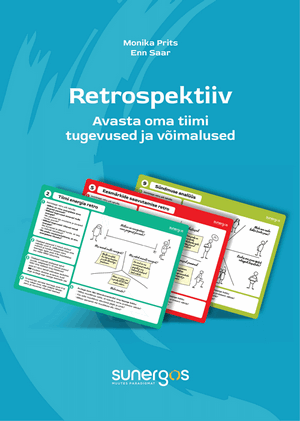
A retro is a tool that makes it possible to analyse quickly and in a structured way what to continue and what to change in how the team works. Get your own set of retro cards here, or contact our development partner Monika Prits, creator of the cards, who also runs trainings on how to make the best use of these cards in your work.
Retrospective Toolbox
- 10 guides for running team retros
- Price €69 (incl. VAT)