One of the most frequent questions I hear when asking leaders about their pain points is “How do I motivate my employees?” Now there is a good opportunity for it.
Throughout history, crises have been the greatest engines of development – at the level of the individual, the company and society. Most often it is some shaking event that forces us to look inside ourselves, discover new perspectives and find new solutions.
Being forced to work from home because of Covid-19 is undoubtedly an event that made it clearer to everyone whether, under what conditions and why they like or don’t like working from home, and leaders had to cope with their fears and prejudices about remote work. This is just one example of the many changes that took place during the crisis. A great many companies changed how work is organised, reshaped the rhythm of meetings or the scheme for monitoring results, communication between people changed, and much more. “It’s all only temporary, we’ll manage,” many thought, and this made it possible to try out and experience quite a few things.
Now, as we restore the usual working rhythm, there is an opportunity to make conscious choices. The easiest thing is to go back to where we left off and simply forget the stressful period. After all, everything worked very well for us. And it did. But things can always be better. A team retrospective is a tool that increases awareness of what happened and gives a simple structure for making choices that help us move towards our goals even faster. In addition, during a team retrospective you learn a lot about each other, which creates safety and increases trust.
Team retrospective
Gather your team and look back together at the crisis period that has passed.
Let everyone think and write on post-it notes (one thought = one post-it) in the form of an I-message:
- I liked…
- I enjoyed…
- I was inspired by…
- I didn’t like / found it hard…
- I was bothered by…
- I think that…
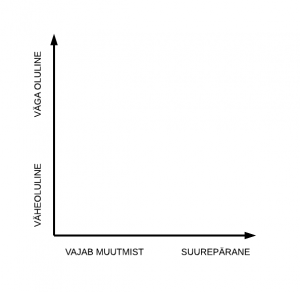
Then everyone comes to the board one at a time, presents their thoughts in turn and places them in a suitable spot on the axes drawn on the board (see the picture).
The others listen and may ask clarifying questions, but it is best to avoid longer discussion at this stage. If someone wants to add thoughts that came up while listening to others, that is very welcome. This is where it becomes very clear what matters to whom and why.
As a next step, group the topics raised and sort them onto three separate sheets headed CONTINUE, STOP, TRY. This can be done in a shared discussion, starting with the most important topics.
In the course of the discussion, the ideas should produce concrete agreements and solutions with owners and deadlines. If there are topics people want to avoid in the future, you need to think about what has to be done and how.
It is useful to make a written summary or memo of the meeting, which becomes the basis for monitoring the implementation of the agreed actions. The leader certainly shouldn’t take on all the responsibility – everyone can choose a topic they like and champion it in the next period. Employees should be willing to take the initiative on topics that matter to them, and the leader then has the chance to notice, encourage and recognise them.
For example, it may turn out that some team members definitely want to continue working in the office as usual, while others would get much more done if they could work from home at least 2 days a week. Or new agreements for organising meetings. The point of the exercise is to identify and become aware of the experience gained and to pick out or create new practices that increase team members’ effectiveness and commitment.
For advanced users, for whom the retro is already a familiar tool, we recommend Geoff Watts’s video for new ideas HERE (10 min).
Happy experimenting!
Download the free retro tool